
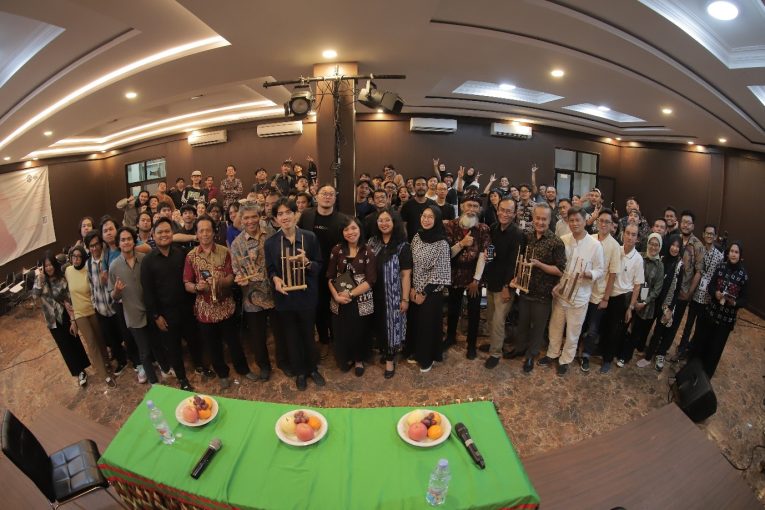
Bandung, 11 November 2025. Two students from the Graduate Program in Performing Arts and Visual Arts Studies (PSPSR) at Universitas Gadjah Mada, Chentrika Matrella Swasti and Moeti Ayudhia Shali, were selected as presenters at the Asian Cultural Echoes: International Conference of Bamboo Music held at ISBI Bandung on 11 November 2025. Of the 19 submitted papers, only 5 were selected for presentation in the main session of the conference, which carried the theme Preserving and Innovating Bamboo Music for Cultural Sustainability.
 In his opening remarks, the Head of the Department of Angklung and Bamboo Music at ISBI Bandung, Dr. Hinhin Agung Daryana, S.Sn., M.Sn., emphasized that the conference aims to encourage international collaboration and to serve as a space for mutually strengthening the exchange of ideas. Similarly, the Dean of the Faculty of Performing Arts, Dr. Ismet Ruchimat, S.Sen., M.Hum., stated that “bamboo music is a source of knowledge that grows alongside its community, so angklung and other bamboo music traditions are not merely entertainment, but also diplomatic devices.”
The conference was attended by participants from various countries, with the majority coming from Indonesia, including students, researchers, community groups, and bamboo music practitioners. Five expert speakers were also present: Prof. Shahanum Binti Ma Shah (Malaysia), Prof. Hendra Santosa (Indonesia), Assoc. Prof. Dr. He Lu (China), Dr. Aton Rustandi Mulyana (Indonesia), and Ribeth Nurvijayanto, S.Sn., M.A. (Indonesia).
 In this forum, Chentrika and Moeti presented their research titled “Cultural Knowledge Circulation: The Dynamics of Pompang Music in Toraja and Mamasa.” The paper explains how cultural knowledge—examined through the case of pompang music—does not merely travel across regions, but undergoes transformation, movement, change, and can eventually circle back to influence its place of origin. Thus, cultural preservation does not mean maintaining an art form exactly as it was, frozen in a glass box; instead, sustainable culture emerges from how meaning is continually given to the art within the time and place in which it lives.
The participation of PSPSR students in this conference reflects their concern for the sustainability of bamboo music traditions and their commitment to engaging in broader academic discourse. This activity supports SDG 4 (Quality Education), SDG 11 (Sustainable Cities and Communities), and SDG 17 (Partnerships for the Goals) through academic exchange, cultural heritage preservation, and international collaboration. (MC)


