
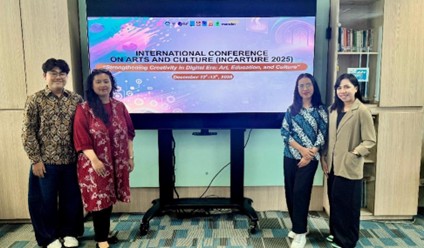
December 2025 – On December 13, 2025, four students from the Performing Arts and Visual Arts Studies Master’s Program at Universitas Gadjah Mada participated in INCARTURE: International Conference on Arts and Culture 2025. Hosted by the Postgraduate Program at the Indonesian Institute of the Arts and Culture (ISBI) Bandung, the conference was held at Universitas Mandiri Bandung.
The event carried the theme “Strengthening Creativity in the Digital Era: Art, Education, and Culture” and featured five keynote speakers: Prof. Endang Caturwati, S.ST., MS. (Indonesia), Prof. Arsenio Nicolas (Thailand), Prof. Dr. Een Herdiani, S.Sen., M.Hum. (Indonesia), Prof. Urip Sulistyo, Ph.D. (Indonesia), and Prof. Valentin Yakushik (Ukraine).
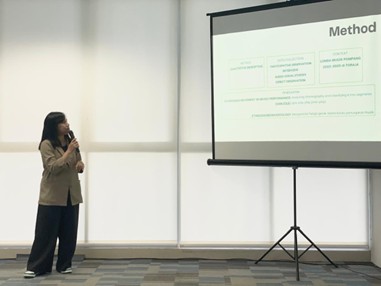
During the conference, four students presented diverse research findings, ranging from issues of preserving traditions to the utilization of technology in the digital age. Chentrika Matrella Swasti, focusing on the theme of Cultural Heritage and Preservation, presented an article titled “Reading Movement in Pompang Mamasa: Ethnochoreomusicology for Cultural Preservation“. This research stems from interest in performance forms where sound and physical movement are inseparable, functioning as a unified event. The study classified the choreography within the structure of the Pompang Mamasa performance and analyzed each segment using Van Zile’s ‘examining movement’ framework. The findings confirm that choreography in musical performances is not merely a supplementary element. Rather, it is prepared and executed with an intention equal to that of the musical components. Such innovation in transforming musical performances into ‘choreo-music’ can serve as an agent for cultural preservation, ensuring its continued relevance to contemporary audiences and the modern era.
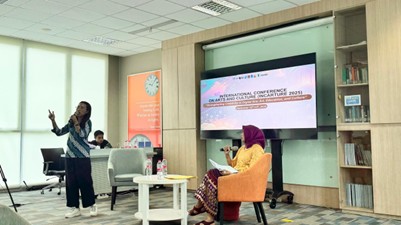
Ketawang Ganda Mastuti, participating under the theme Integrating Art, Technology, and Cultural Literacy, presented an article titled “Negotiating Tradition and Continuity: The Integration of Keyboard as a Gamelan Substitute in Wayang Kulit Performances in Temanggung“. This research examines the phenomenon of integrating keyboards as a substitute for the gamelan ensemble in wayang kulit (shadow puppet) accompaniments in Temanggung, Central Java. It explores the process of technological negotiation within traditional art as a response to the tension between cultural continuity and the demands of modernity. By analyzing this phenomenon through Claire Holt’s ‘change and continuity’ framework, the study demonstrates that the integration of the keyboard reflects the flexibility of traditional arts amidst dynamic socio-cultural conditions.
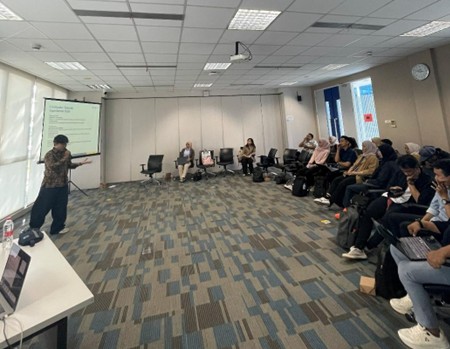
Krisna Tama, participating under the theme Photography, Film, and Digital Media, presented an article titled “PANGKU and Making Belief in Indonesian Cinema“. This paper examines the actor’s performance in the film Pangku by synthesizing Stanislavsky’s realist system, Kirby’s acting/not-acting spectrum, and Schechner’s concept of make-belief to explain how theatrical techniques are adapted within cinema. The research findings indicate that the performance on screen aligns with Stanislavsky’s principles, specifically given circumstances, the magic if, and subtext, resulting in a profound naturalism. Simultaneously, Kirby’s spectrum reveals a precise calibration between minimal presence (received acting) and full embodiment (complex acting), particularly during portrayed moments of silence and indifference. Ultimately, the interconnectedness of these techniques, as interpreted through Schechner, fosters a make-belief effect that facilitates a liminal transition for the audience, moving them from an awareness of fictionality toward a deep and veridical emotional experience.
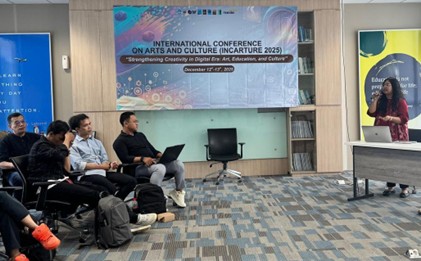
Moeti Ayudhia Shali presented an article titled “Performing Intangible Heritage: The 24-Hour Dancer’s Body as a Representation of Banyuwangi Identity in World Dance Day at ISI Surakarta 2025”, categorized under the sub-theme Cultural Heritage and Preservation. This article discusses the embodied experience of a Gandrung Banyuwangi dancer in the solo work “Behind the Eyes” performed during the World Dance Day (HTD) event at ISI Surakarta. The research focuses on the dancer’s bodily experience, which serves as a ‘living text’ representing the identity, memory, and cultural symbols of Banyuwangi. Through the lens of restored behavior analysis, the study finds that elements of movement, costume, and music do more than just restage Gandrung dance in a modern space; they function as a medium for cultural preservation through embodied experience. This performance proves that the dancer’s body is a dynamic preservation strategy for intangible cultural heritage, continuously negotiated through contemporary performance practices.
The participation of these four students contributes significantly to several Sustainable Development Goals (SDGs), including:
- SDG 4: Quality Education – Demonstrating academic and research advancement in higher education by utilizing local subjects to enrich the treasury of scientific – knowledge.
- SDG 9: Industry, Innovation, and Infrastructure – Representing the conference theme through support for the sustainability of local cultural expression via innovation and the utilization of technology.
- SDG 11: Sustainable Cities and Communities – Contributing research findings that highlight efforts to strengthen community identity and its existence amidst contemporary dynamics.
- SDG 17: Partnership for the Goals – Engaging in a conference that fosters collaboration between universities and academic experts from various countries, thereby creating a vast space for knowledge exchange. (MK)


