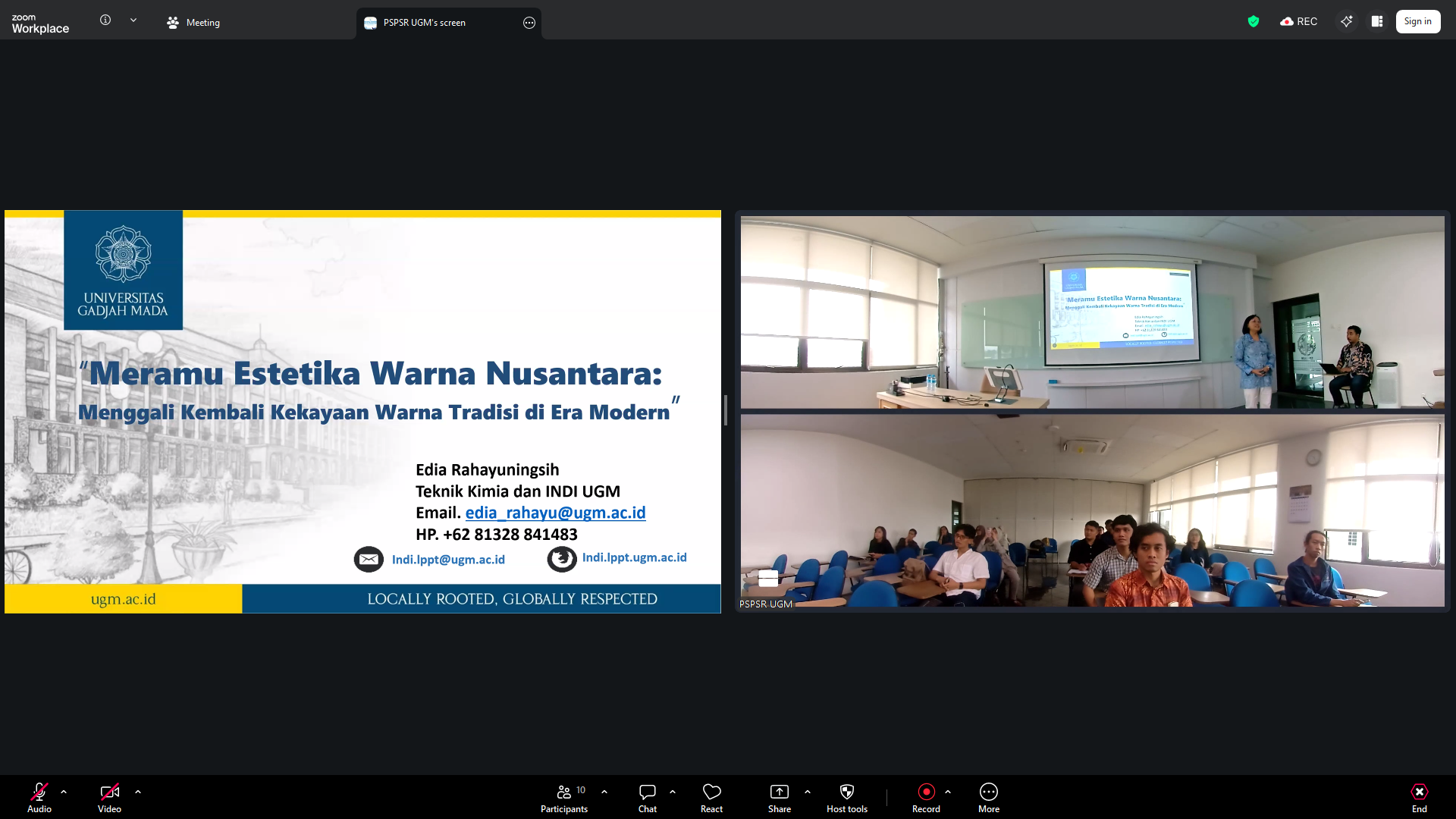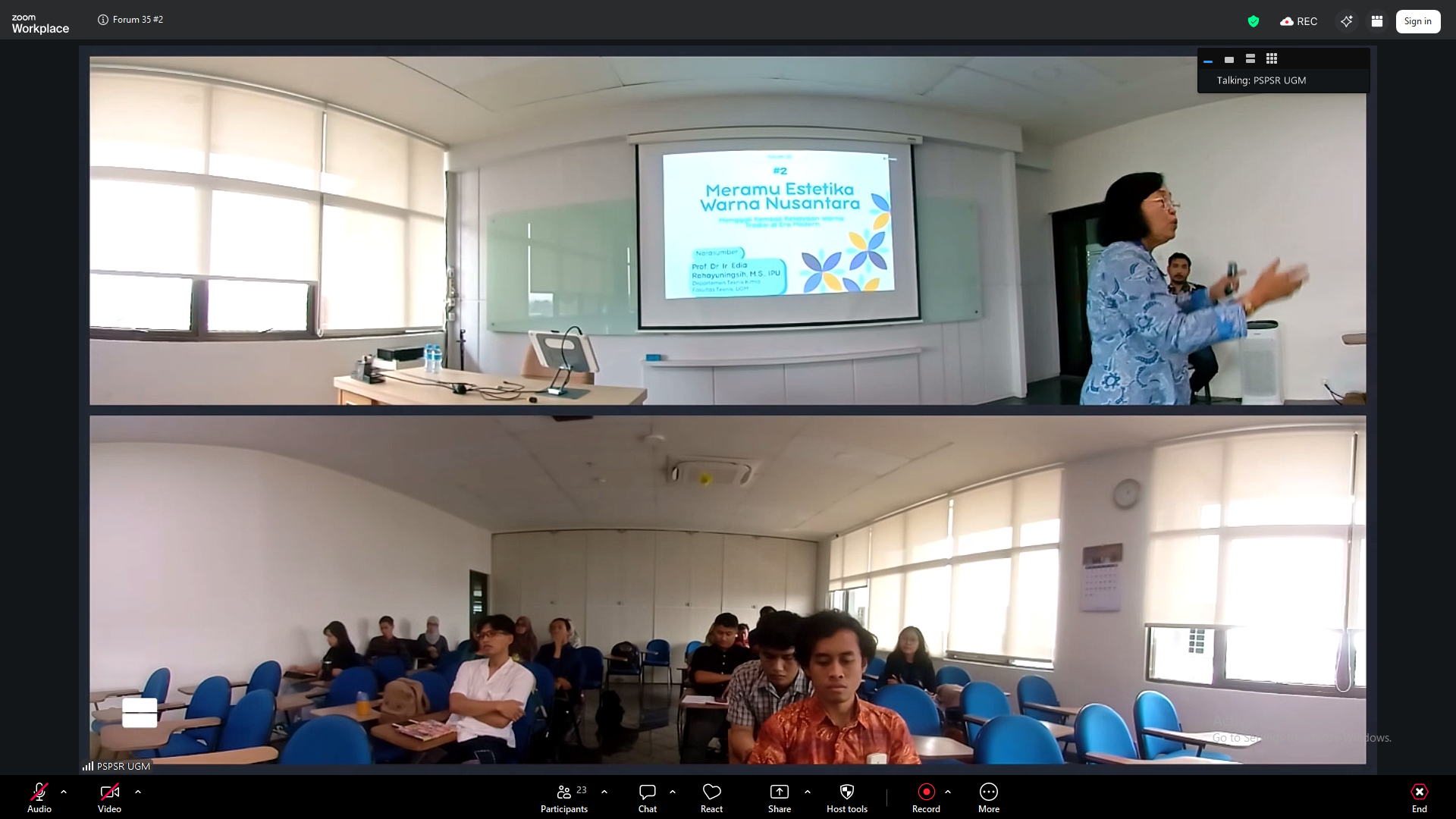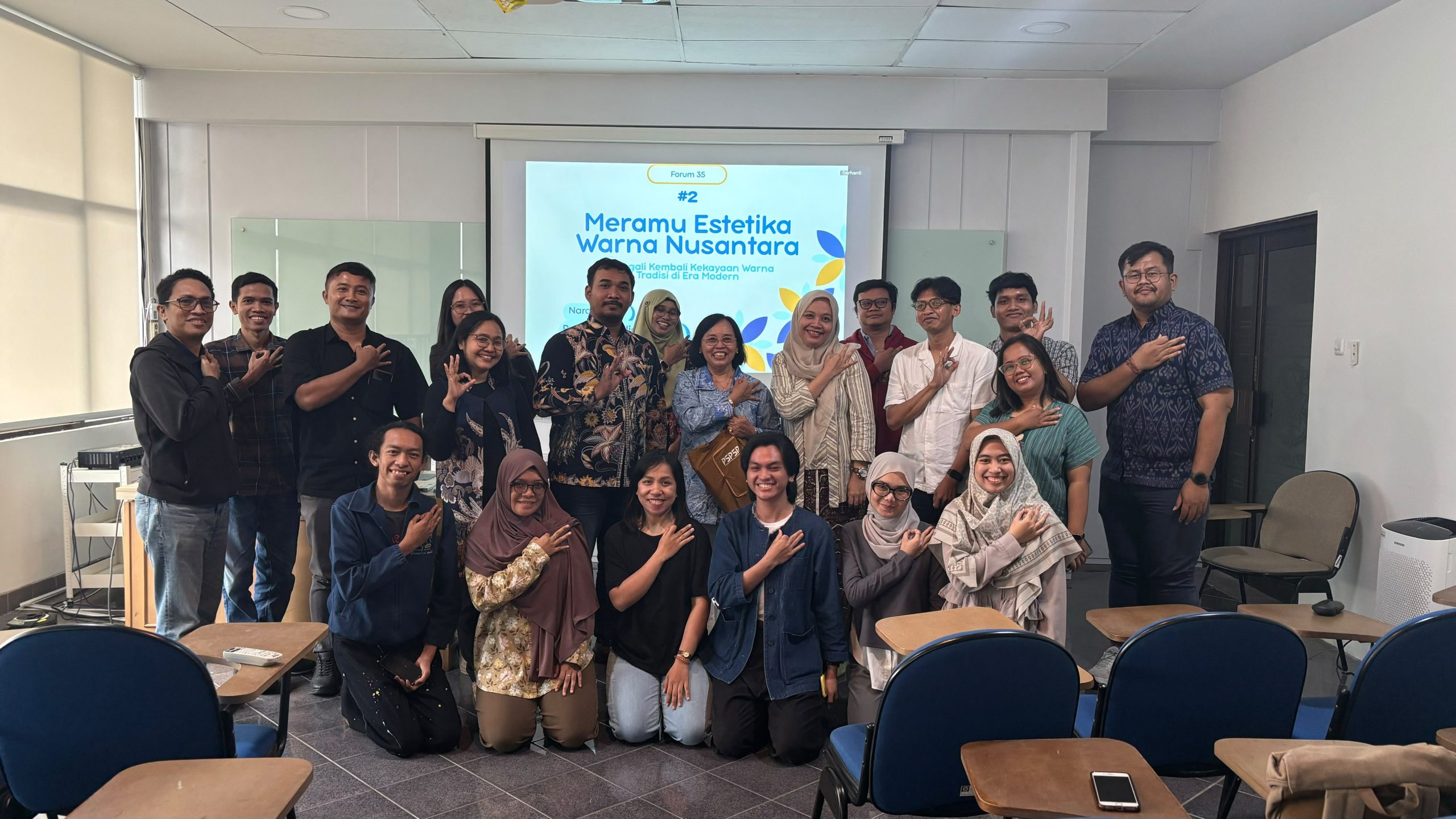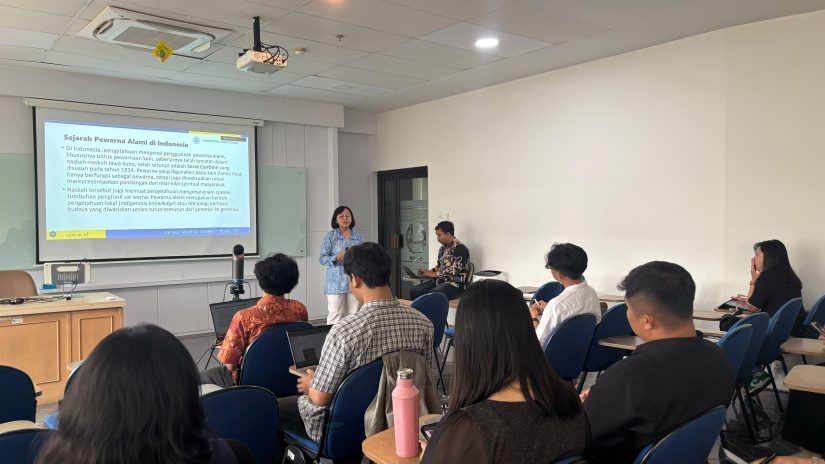
Yogyakarta, 25 Juni 2026 – The Performing Arts and Visual Arts Studies Program (PSPSR), Graduate School of Universitas Gadjah Mada, held its Forum 35 #2 under the theme “Formulating Nusantara Color Aesthetics: Rediscovering the Richness of Traditional Colors in the Modern Era.” The event was organized as part of the PSPSR UGM Anniversary series, serving as a cross-disciplinary meeting space for art, science, technology, and culture.
Held in a hybrid format via Zoom, this public forum captured deep attention from all participants. The discussion was highly interactive, particularly during the question-and-answer session. The event featured a Professor from the Department of Chemical Engineering, Faculty of Engineering UGM, Prof. Dr. Ir. Edia Rahayuningsih, M.S., IPU., as the keynote speaker. In her presentation, the expert—who focuses on the production and application of natural textile dyes—emphasized the importance of preserving natural colorants. According to her, this Nusantara traditional heritage is not only aesthetically valuable but also offers a tangible solution to health and environmental sustainability issues.
The event was officially opened by the Head of the PSPSR UGM Study Program, Dr. Rr. Paramitha Dyah Fitriasari, M.Hum. In her remarks, she stated that Forum 35 is part of the PSPSR UGM Anniversary series designed as a platform for cross-faculty and multidisciplinary knowledge sharing. Through this forum, PSPSR aims to bring together lecturers and experts from various fields so that students can broaden their academic perspectives and connect this knowledge with performing arts and visual arts studies.
The theme of traditional colors was chosen because color is a highly vital aesthetic element in Nusantara culture. Across various art forms—such as batik, weaving, songket, performance makeup, costumes, and stage props—color functions not only as a visual element but also carries philosophical values, symbols of social status, regional identity, and local wisdom. In the past, many traditional colors were produced by processing natural materials such as roots, tree bark, leaves, minerals, and other natural sources through processes deeply intertwined with community local knowledge.
Through a chemical engineering perspective, the forum invited participants to understand how natural dyes can be produced, developed, and applied across various mediums. The discussion went beyond the use of natural dyes for fabrics, exploring potential applications in visual arts, artistic design, performance costumes, and contemporary creative practices. Consequently, natural dyes can be viewed as a bridge connecting traditional knowledge, applied technology, and modern art creation.
The forum also highlighted that nearly every region in Indonesia possesses local knowledge of natural dyes passed down through generations. This knowledge constitutes a crucial part of Nusantara’s cultural wealth that must be studied, preserved, and redeveloped. Amidst the dominance of synthetic dyes that pose risks to the environment and health, the use of natural dyes serves as an important alternative in building a more sustainable art and creative industry practice. This aligns with UGM’s commitment to the Sustainable Development Goals (SDGs):
- SDG 12 (Responsible Consumption and Production), through the utilization of eco-friendly natural dyes,
- SDG 15 (Life on Land), regarding the preservation of biodiversity as a source of natural colors.
Through this initiative, PSPSR UGM hopes to foster an interdisciplinary dialogue between applied science and art, particularly in reinterpreting the position of Nusantara’s traditional colors in the modern era. The forum is also expected to inspire further research ideas on revitalizing traditional colors in performing arts, visual arts, textiles, design, and other contemporary cultural practices. (BBAP, NA)