
The cultural mission in the Indonesian homeland had been implemented after Indonesia’s independence in 1945. For Sukarno, it was through culture that Indonesia could demonstrate independence, as well as its cultural diversity. On that basis, Sukarno had carried out a cultural mission by sending various artists abroad. In short, the cultural mission kept Sukarno’s foreign policy agenda. Also an Indonesianist, Jennifer Lindsay also wrote that: Many cultural missions were sent abroad by President Soekarno in the 1950s and 1960s. The mission, which usually consists of dancers and musicians, is intended as an expression of ‘national confidence and pride’ (Lindsay, 2012: 195). While agreeing with this, in her writing Barbara Hatley stated that in that era there was indeed an agenda of creating an advanced national culture for the Indonesian nation (2014: 4).
But apart from the cultural mission, our culture has also visited various countries during the colonial era. Such as the gamelan performance at the L’Exposition Universelle (Exhibition of the Universe) which was held in Paris in 1889 to commemorate the 100th anniversary of the French Revolution. It was there that the Sundanese Sari Oneng gamelan from the village of Parakan Salak, near Sukabumi was performed, among other things to accompany four dancing girls at the Mangkunegaran palace, Solo (Perlman, 1994: 512; Sorrell, 1992: 66; Wachsmann, 1973: 7; Wibsiono, 2012: 12) [3]. As a result, various exchange interactions have also become a continuous pattern, but with different agendas or goals.
Lately, similar cultural missions are still being carried out, whether linked to the government or the private sector. Even in the form of art, it has also undergone changes, from traditional arts to traditional to contemporary arts. Instead of only sending cultural missions, various other interaction activities also took place, from festivals to residencies. From this, we can see the various forms of cultural interaction that have developed but still have the aim of disseminating Indonesia, or of diplomizing Indonesian culture through the arts. However, we need to further investigate several things, such as: How is the construction of domestic and foreign diplomacy designed? How the academics and artists could read the construction of cultural diplomacy? To what extent does art have a say in determining the agenda for cultural diplomacy? How does cultural diplomacy have bargaining power for the arts? This is important to do in order to design an understanding of what cultural diplomacy would like to proclaim in the future, by looking at the past and the present. If this is done with critical power, presumably cultural diplomacy applied at home or abroad can act synergistically, so that the arts can play an important role in the design of future cultural strategies.
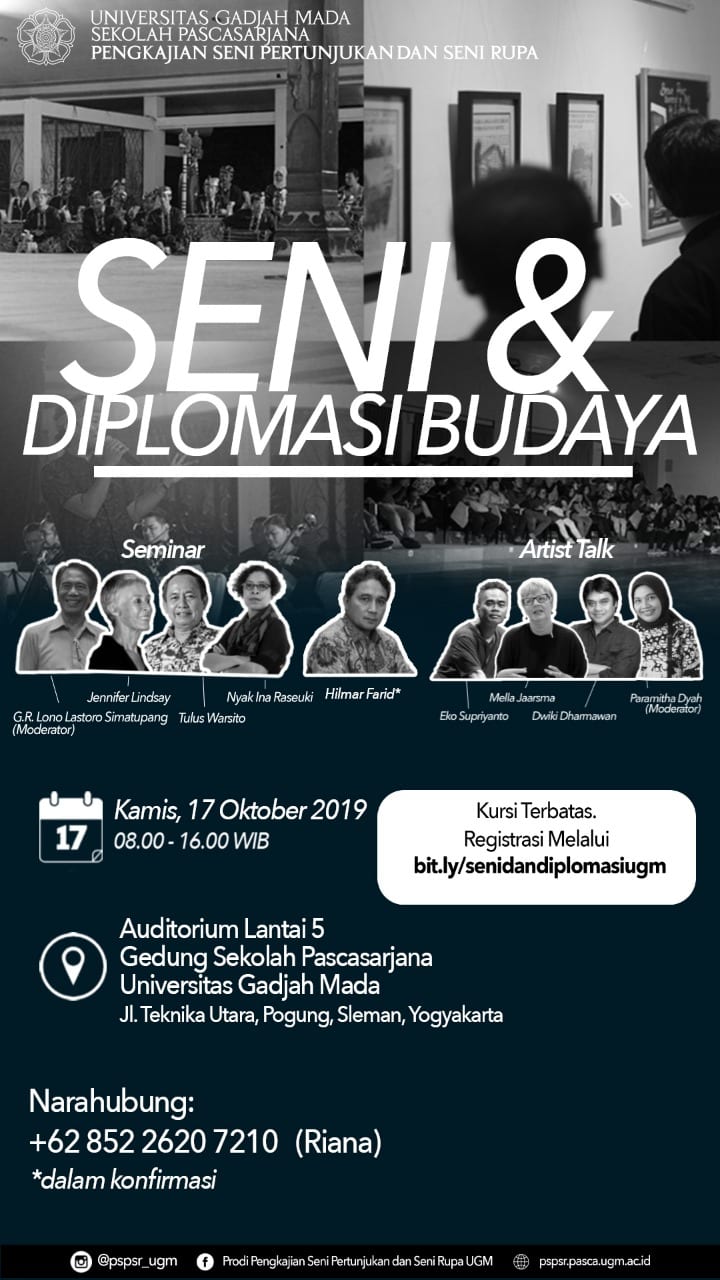
Therefore, we present speakers:
Keynote Speaker:
Hilmar Farid
First Session Speaker:
- Jennifer Lindsay
- Nyak Ina Raseuki
- Sincere Warsito
Moderator: G.R. Lono Lastoro Simatupang
Second Session Speaker:
- Mella Jaarsma
- Eko Supriyanto
- Dwiki Dharmawan
Moderator: Rr. Paramitha Dyah F.